









This haunting debut feature about a group of schoolgirls shielded from the modern world is best described as ‘Dogtooth’ meets ‘Petite Maman’, marked by an unsettling sound design and an acute sense of false normalcy.
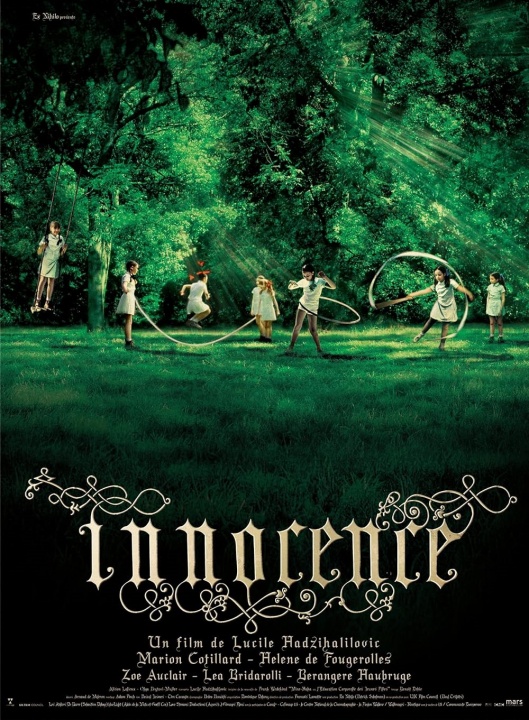
Review #2,695
Dir. Lucile Hadzihalilovic
2004 | France | Drama, Mystery | 120 min | 2.35:1 | French
Not rated – likely to be NC16 for some sexual content and brief nudity involving a minor
Cast: Zoe Auclair, Lea Bridarolli, Berangere Haubruge, Marion Cotillard, Helene de Fougerolles
Plot: Deep in a forest, in a mysterious girls’ boarding school walled off from the world, a group of girls gather around a coffin, from which emerges new pupil Iris. She enters a world of ballet classes, bizarre rituals, and few adults. But Iris is forbidden from discovering what lies beyond the school.
Awards: Official Selection (Toronto)
International Sales: Wild Bunch
Accessibility Index
Subject Matter: Moderate – Isolation; Power & Domination; Gender & Society
Narrative Style: Slightly Complex
Pace: Slightly Slow
Audience Type: Slightly Arthouse
Viewed: MUBI
Spoilers: No
Some might know Lucile Hadzihalilovic as the spouse of the French enfant terrible Gaspar Noe, but in her first feature, Innocence, she comes fully formed as a filmmaker. This haunting film portrays a world unlike ours—a sheltered one, but mysterious and somewhat sinister.
Groups of schoolgirls are shielded from the modern world in a secluded forested location, free from boys (and men). These girls wake up in coffins and are assimilated into a new way of life that requires them to follow strict rules and timetables.
There is no indication as to what their ‘old’ lives might be, or where they have come from. Were they abandoned, or worse, abused? They each seem to possess an air of innocence and a purity of mind.
A young Marion Cotillard plays one of the school’s few teachers, who teaches the girls ballet—but to what end? Hadzihalilovic, for the most part, keeps things secretive.
“Will I be punished too?”
Best described as Dogtooth (2009) meets Petite Maman (2021), Innocence even pulls sound design strategies out of David Lynch’s playbook, creating an atmosphere that feels unsettling.
Buzzing low tones accompany montages of eerie basements and tunnels, providing a counterpoint to the much more blissful realm above. The contrast isn’t any more pronounced though because Hadzihalilovic depicts whatever transpires in the school with an acute sense of false normalcy.
Many will read Innocence allegorically through the lens of gender and society, as well as power and domination. But for me, this is fabulist cinema, in both senses of the word.
It is not just the director’s approach to storytelling and visual style that evokes a fable-like quality, but also its cinema of lies, of hidden trickery and treachery toward its characters.
Grade: A-
 Eternality Tan