







Triet’s third feature suffers somewhat from haphazard editing as it tells a fragmentary story about a psychotherapist who finds renewed motivation as a writer as she becomes embroiled in the affairs of an aspiring actress.
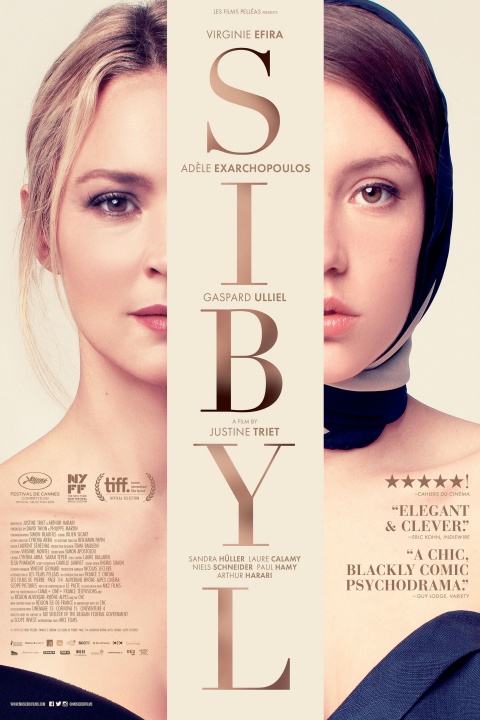
Review #2,677
Dir. Justine Triet
2019 | France | Drama | 101 min | 2.39:1 | French, English & Italian
R21 (passed clean) for sexual scenes
Cast: Virginie Efira, Adele Exarchopoulos, Gaspard Ulliel, Sandra Hüller, Laure Calamy
Plot: Lacking inspiration for her new novel, psychotherapist Sibyl borrows source material from the life of her newest patient Margot, a young actor wrapped up in a dramatic affair with her co-star, Igor. Becoming further enmeshed in Margot’s life, Sibyl starts to blur fiction with reality.
Awards: Nom. for Palme d’Or (Cannes)
International Sales: MK2
Accessibility Index
Subject Matter: Moderate – Psychotherapy; Writing; Filmmaking & Acting; Fiction vs. Reality
Narrative Style: Slightly Complex
Pace: Normal
Audience Type: Slightly Arthouse
Viewed: MUBI
Spoilers: No
While I eagerly await Justine Triet’s new Cannes Palme d’Or-winning Anatomy of a Fall (2023), her previous film, Sibyl, doesn’t quite inspire confidence.
Her third feature then, Sibyl tells a story about an ex-alcoholic psychotherapist who finds renewed motivation as a writer, particularly after she becomes embroiled in the affairs of an aspiring actress.
Perhaps the film itself is in need of psychotherapy as it comes across as rather schizophrenic. Though some might argue that that is the point, I can hardly see past its somewhat haphazard editing which produces a start-stop affair filled with sudden flashbacks.
As a film, Sibyl doesn’t really get going—it frustrates, yet at the same time, there is a great film in there waiting to burst out.
Headlined by Virginie Efira (who later played the titular nun in Verhoeven’s provocative Benedetta (2021)) and Adele Exarchopoulos (best known for Blue Is the Warmest Color (2013)) as doctor and patient respectively, Triet’s work can be quite sexually-charged as the characters try to navigate their palpable desires.
“A bit of guilt never hurts.”
The film’s most memorable performance to me, however, is the almost caricature-like display by Sandra Huller, who plays a self-indulgent film director trying to keep her cool on a film set.
Speaking of which, Sibyl becomes more dramatically involved when we see everyone isolated on a shoot at Stromboli, as stressors escalate and explode.
In some way, Triet seems to be going for a meta-filmic quality—a movie about psychotherapy as cinema is forced to reckon with its inverse i.e. cinema as psychotherapy. Fiction, reality, memory and delusion all act on each other, producing a flustering blur.
It’s already a hazy film, to begin with, and while Sibyl is a tricky, incoherent customer, it’s clear that Triet is trying something layered though not quite succeeding.
Grade: B-
Trailer:
Music:
 Eternality Tan
[…] far been a hit-or-miss director. I was impressed with her first feature, Age of Panic (2013), but Sibyl (2019) left me rather […]
LikeLike
[…] I would recommend that you check out Triet’s three prior works, including the admittedly uneven Sibyl (2019), because you will find that they each contain ideas and themes—some already fully formed, […]
LikeLike