








A faltering work of great ambition, or an artistic triumph bogged down by chronic unevenness, Gomes brings to it a plethora of aesthetical styles and nonchalant attitude towards film form to deliver a biting satire on Portugal’s politics, economy and culture.

Review #2,650
Dir. Miguel Gomes
2015 | Portugal | Drama | 367 min | 2.35:1 | Portuguese & other languages
R21 (passed clean) for nudity
Cast: Crista Alfaiate, Carloto Cotta, Adriano Luz, Rogerio Samora, Maria Rueff
Plot: Scheherazade tells King Shahryar her stories but these are not those in the book. These are stories based on whatever will happen in Portugal during the film’s production time. It will be about the reality of a disgraced country under the effects of a global economic crisis.
Awards: Official Selection (Cannes)
International Sales: The Match Factory
Accessibility Index
Subject Matter: Moderate – Portugal in Crisis; Political, Social & Economic Allegory
Narrative Style: Slightly Complex/Vignette-Style
Pace: Slow
Audience Type: General Arthouse
Viewed: MUBI
Spoilers: No
Unlike Pier Paolo Pasolini’s version back in 1974, which was much closer in spirit to the source text, Miguel Gomes’ take on ‘Arabian Nights’ is decidedly less reverential and more oblique.
Loosely utilising the famous premise of Scheherazade narrating one tale each night to King Shahryar so as to be kept alive for as long as possible, Gomes turns it into a three-parter with disparate stories.
Some segments aren’t even narratives, such as the extended documentary on a group of men obsessed with the birdsongs of chaffinches that make up a major part of the third film, incidentally also the weakest of the trio.
The straightforward anthological approach to the second film, however, makes it the strongest with self-contained stories that aren’t just coherently told but also express a quality of magical absurdism.
Look out for one segment involving an open-air legal trial where a no-nonsense judge oversees a bizarre case involving stolen cows, a genie, a human lie detector, mail-order brides and more.
“Do you want to hear what I’ve seen, or what I know from having heard?”
The first film is also an odd concoction, with its plethora of aesthetical styles and a nonchalant attitude towards film form. As such, one might be hard-pressed not to call Gomes’ Arabian Nights radical.
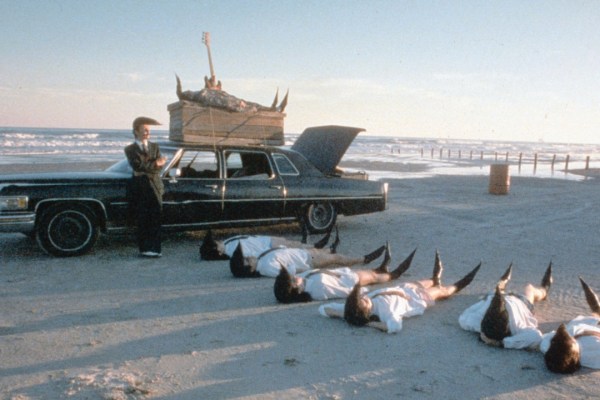
Depending on how you take to the film, it might be a faltering work of great ambition, or an artistic triumph bogged down by chronic unevenness. There are many ups and downs, moments of utter brilliance (cue ministers with permanent boners) but also scenes that don’t work at all.
(A digression: the main issue of the version that is streaming on MUBI is that the Portuguese text-on-screen doesn’t come with English subtitles, so it can be difficult (or more accurately, frustrating) to try to make sense of things.)
That said, I think most will agree there’s nothing quite like Gomes’ film in contemporary arthouse cinema—as much as it functions as a biting satire on Portugal’s politics, economy and culture, it also feels like a travelogue that somewhat overstays its welcome.
Grade: B
Trailer:
 Eternality Tan
[…] the Best Director award at Cannes, the Portuguese auteur of such works as the ‘Arabian Nights’ trilogy (2015), The Tsugua Diaries (2021), and what could be one of the films of the 2010s […]
LikeLike