




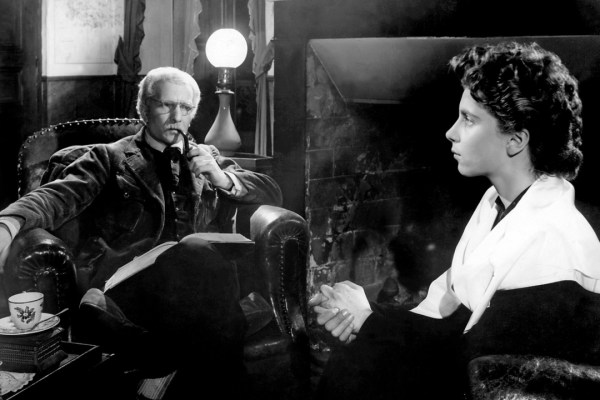

Some may feel Hong’s doing something different here—it’s more self-introspective and structurally liminal, but also slower and more meandering than usual as a film director brings his daughter to visit an old friend who might offer her career advice.

Review #2,636
Dir. Hong Sang-soo
2022 | South Korea | Drama | 97 min | 1.85:1 | Korean
Not rated – likely to be PG13
Cast: Kwon Hae-hyo, Lee Hye-young, Song Sun-mi, Cho Yun-hee, Park Mi-so
Plot: A middle-aged film director and the daughter he hasn’t seen in years visit a building owned by an interior designer.
Awards: Official Selection (Toronto)
International Sales: Finecut
Accessibility Index
Subject Matter: Moderate – Human Relationships; Time & Space
Narrative Style: Slightly Complex
Pace: Slightly Slow
Audience Type: Slightly Arthouse
Viewed: Screener
Spoilers: No
Longtime fans of Hong Sang-soo will probably notice a slight shift in his style here with Walk Up, a rather nondescript effort by his standards though it may please audiences who enjoy films set almost entirely in a single location. In this case, we have a property with a few floors containing some faces that will soon become familiar to us.
A circular stairway provides a linkway for ‘walking up or down’, a transitional point it seems for Hong to not just explore spaces but also temporalities. In that sense, Walk Up could be Hong’s cheeky attempt at a time travel movie.
A film director (played by his frequent collaborator Kwon Hae-hyo) brings his somewhat estranged daughter to visit an old friend whom he hopes might offer her career advice in the field of design.
As the other characters drift in (and out) of conversations over soju (more often wine), we begin to feel the subtle effects of ‘alternate realities’ becoming more explicit.
“People don’t know what he’s really like.”
As such, the film may be described as structurally liminal, where you don’t quite see the columns that hold the narrative up, so to speak.
From this perspective, Hong’s work appears to be fascinating but unfortunately, it is bogged down by its slower pacing than usual. I found it more meandering than insightful—conversations about being a filmmaker are aplenty and are very much self-praising.
Some may find Hong to be genuinely reflecting on himself as a celebrated artist; others may feel, however, that these musings aren’t new in his oeuvre, tiresome even.
The black-and-white cinematography is as pristine as it can be though, and the film features one of his most enigmatic codas to date. Still, just like The Novelist’s Film (2022), I can’t be sure that I really enjoyed it.
Grade: B-
Trailer:
 Eternality Tan