


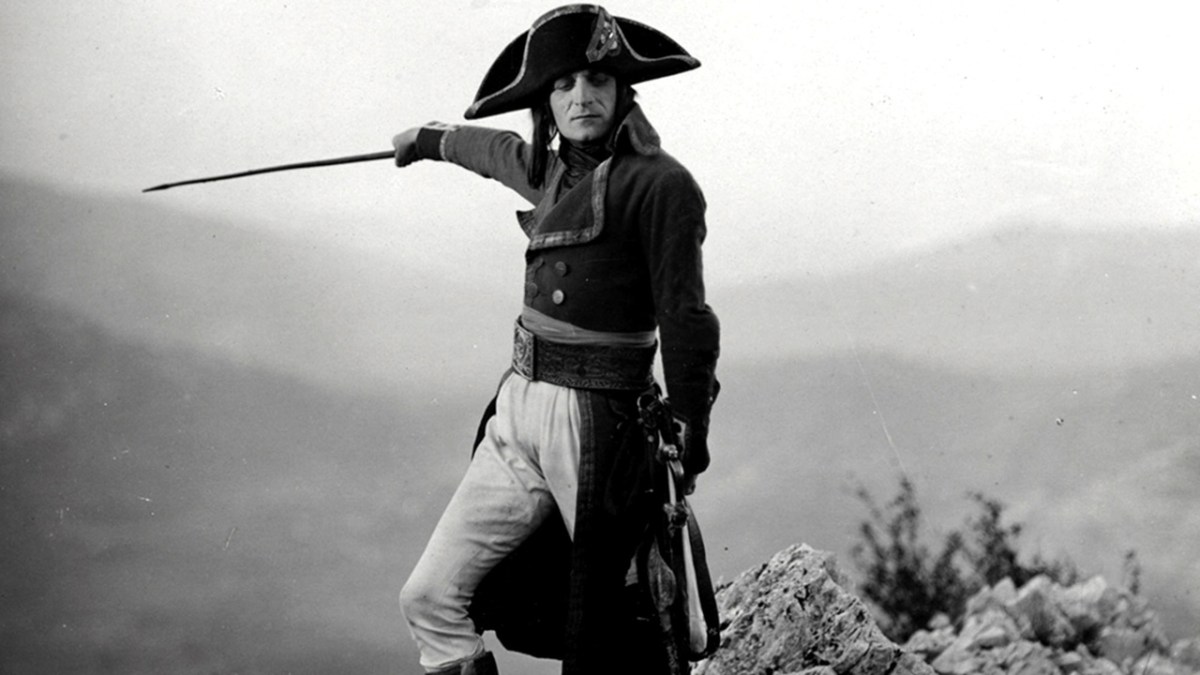
This 5 ½ hour-long French silent masterwork is an undisputed milestone of its era, telling the story of one of the most famous military leaders in history with eye-opening innovation that still remains startling today.

Dir. Abel Gance
1927 | France | Biography/Drama/History | 333 mins | 1.33:1 | Silent
Not rated – likely to be PG
Cast: Albert Dieudonne, Gina Manes
Plot: This epic biopic of Napoleon traverses many of the formative experiences that shaped the French leader’s rapid advancement: from his days in school to his flight from Corsica, as well as the French Revolution and the Terror, and culminating in his triumphant invasion of Italy in 1797.
Awards: –
Source: British Film Institute
Accessibility Index
Subject Matter: Moderate – History, War & Politics
Narrative Style: Slightly Complex
Pace: Slightly Slow
Audience Type: Slightly Arthouse
Viewed: MUBI
Spoilers: No
I’ve been wanting to see this for the longest time having heard of its legend, and I wasn’t a tiny bit disappointed. If there’s a gripe, it would be its long runtime, at 5 ½ hours, which I needed to tackle in several sittings.
But director Abel Gance, the French answer’s to D.W. Griffith, told the story in four quite digestible acts, with timely intermissions to boot. The result is a stunning silent masterwork that is up there as one of the greatest films in history, and not just in the silent era.
Viewing it now, nearly a century later, it is firstly a blessing to still be able to see something like this so meticulously restored, and re-scored with new music by Carl Davis.
It is also startling to see some of the eye-opening innovations on display such as the use of handheld cameras, and in the famous three-camera triptych sequence in the final reel of the film, a super widescreen aspect ratio of 4.00:1 that gives a panoramic view of Napoleon’s invasion of Italy (this pre-dating Cinerama by decades).
From a narrative point-of-view, Gance’s work mostly covers Napoleon’s time as a rising commander during the French Revolution and the various political and military obstacles he had to face and endure.
It gives a grandiose sweep of his personal story set against the larger sociopolitics of the time, though even at such a lengthy runtime, the film is still more interested in historical breadth than character depth, which some might find an issue.
Still, it doesn’t get any more epic than Napoleon, and the way Davis weaves strains of the French national anthem, “La Marseillaise”, into the orchestral score gives us some of the film’s most emotional and triumphant moments.
Grade: A+
Trailer:
Music:
 Eternality Tan
[…] no further than Abel Gance’s 5½-hour-long 1927 silent epic if you want arguably the finest screen treatment of one of France’s most infamous historical […]
LikeLike